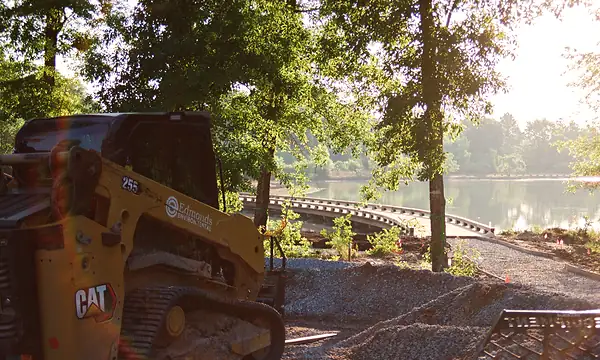
Does your sloped yard actually need a retaining wall?
Most homeowners start thinking about retaining walls after something goes wrong. Water pooling at the base of a slope. Mulch washing downhill after every rain. A backyard too steep to use. A driveway edge that keeps crumbling no matter how many times it gets patched.
These are real problems, and in many cases a retaining wall is part of the answer. It's rarely the whole answer, and it's almost never the first thing to figure out. The distinction between a slope that looks steep and a slope that needs structural intervention takes more than a visual read. Grade, soil type, water movement, and what's adjacent to the slope all affect the diagnosis.
The situations that reliably point toward structural retention: a slope with active erosion that plant material isn't holding, a grade change adjacent to a patio, driveway, or occupied structure, a backyard losing usable space to a significant grade drop, or an existing wall already showing cracks, lean, or moisture at the face. Getting that diagnosis right before material selection is where the project either goes well or doesn't.
“The wall is part of the drainage system. The sooner that's understood, the better the finished result holds up.”
Why Alabama clay soil makes drainage a structural requirement
Alabama clay doesn't drain. It holds water, expands when saturated, and contracts as it dries. On a slope, that cycle creates pressure behind any vertical face built to hold it. The Alabama Cooperative Extension has documented what happens when drainage is blocked on clay-heavy lots: water accumulates, has nowhere to go, and generates the hydrostatic pressure that cracks or topples walls. The failure shows up in the first few years rather than at the end of a long service life.
This is why every retaining wall project Edmonds Environmental takes on starts with drainage analysis, not material selection. Batter angle, aggregate backfill depth, drain tile placement, and weep hole spacing are structural decisions. Get them wrong and the wall fails regardless of how good the block or stone looks at installation. Alabama's long wet seasons and heavy rain events are not edge cases to design around. They're the standard condition.
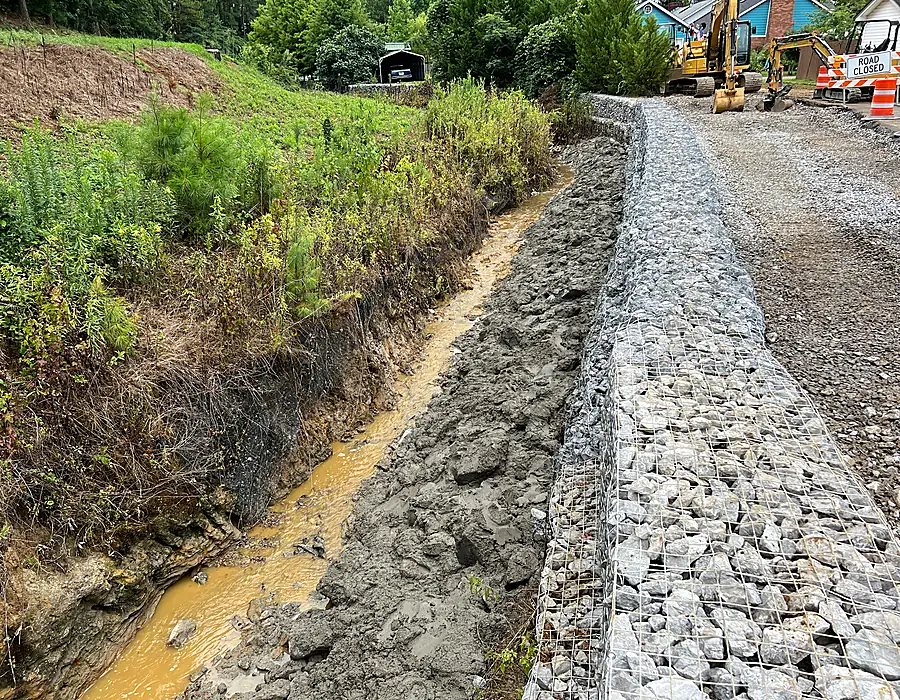
Retaining wall, grading, or drainage correction: choosing the right solution
The most useful thing a contractor can do for a sloped property is give an honest read on what the problem actually calls for.
Grading alone resolves many slope issues when the grade change is moderate and the goal is improved drainage or a gentler transition between yard areas. Reshaping contours and establishing positive drainage away from the foundation handles more situations than homeowners expect, and at lower cost than structural work.
Drainage correction is the right tool when water is the primary problem rather than grade change. A low area that pools after every rain but sits on otherwise stable ground usually needs French drains, swales, or catch basins, not a retaining wall.
Plant stabilization works on shallow slopes with moderate erosion. Dense groundcover root systems hold soil and slow surface water. It's a reliable complement to structural work, not a substitute when slopes are steep or erosion is active.
A retaining wall is the clear answer when grade changes exceed two feet, when the slope is adjacent to a structure or hardscape, when drainage correction alone won't stabilize the grade, or when usable space needs to be created and held at a fixed elevation.
Retaining wall materials for Alabama properties
Material choice is partly structural, partly aesthetic, and heavily influenced by what the rest of the property asks for.
Segmental retaining wall block is the most common residential choice in Alabama. It handles drainage requirements well when base preparation and backfill are correct, and comes in profiles from utilitarian to refined. Wall height, batter angle, and whether geogrid reinforcement is required matter as much as which block goes on the face.
Natural stone gives a more permanent, architectural quality. Dry-stack limestone, boulders, and fieldstone walls suit properties where the home and landscape have a regional character worth reinforcing. They take more time and more experienced hands, and that shows in the finished result.
CMU walls with stone or brick veneer work where the wall is load-bearing or needs to match existing masonry on the home. These are engineered walls in most situations.
Seating walls and tiered systems do structural work, drainage work, and design work simultaneously. A terraced backyard planned as a single composition, wall, patio, planting, and outdoor kitchen together, produces a different result than elements assembled in sequence after the grade is already set.
Retaining walls in Tuscaloosa, Northport, and Mountain Brook
Site conditions, lot character, and what a retaining wall needs to accomplish differ meaningfully across the markets Edmonds Environmental serves.
Tuscaloosa
Older residential lots in Tuscaloosa, particularly near the river and through established neighborhoods, often have grade changes at the rear property line where the backyard meets a drainage corridor, alley, or neighboring lot drop. The problem usually presents as a crumbling edge or eroding bed rather than an obvious wall site until the grade is evaluated properly. Driveway edges on sloped streets are another common application, where soil movement against hardscape needs structural retention rather than repeated patching.
Northport
Larger residential lots in Northport with significant slope from street to rear of property are well-suited to terracing rather than a single tall wall. Distributing the grade change across two or three lower walls with usable space between them creates more outdoor living area and reduces the structural demand on any single wall. Drainage planning on Northport lots needs to account for the volume of water moving across larger sites during heavy rain events, particularly where rear lot lines meet drainage easements or natural grade breaks.
Mountain Brook
Steep wooded lots in Mountain Brook present the most complex retaining wall conditions in the region. Mature tree root zones, proximity to structures, premium material expectations, and the relationship between walls and outdoor living spaces above them require careful coordination. Stone and brick compatibility with existing architecture matters more here than in other markets, and engineered wall solutions are more common given slope severity. Mountain Brook also has specific permit requirements: walls must be submitted through City Hall by a state-certified card holder, and that process should start early in project planning.
Permits and engineering requirements in Alabama
Alabama requires permits for retaining walls over four feet tall. Walls over 24 inches supporting a surcharge load, meaning a driveway, parking area, structure, or another wall above them, require engineered design regardless of height. This is the statewide baseline.
In Tuscaloosa, applications run through the city building department with documentation covering wall height, drainage, and a stamped engineering plan for taller walls. In Mountain Brook, permits are handled through City Hall and must be submitted by a state-certified card holder. Northport projects follow Jefferson or Tuscaloosa County guidelines depending on parcel location.
Practically: a decorative garden wall under two feet with no load above it typically doesn't require a permit. A wall over four feet, a wall adjacent to a driveway or structure, or a wall that's part of a larger grading and drainage scope almost certainly does. Starting that process late is significantly more complicated than starting it early. Edmonds Environmental handles permitting as part of project planning, not as a follow-up step.