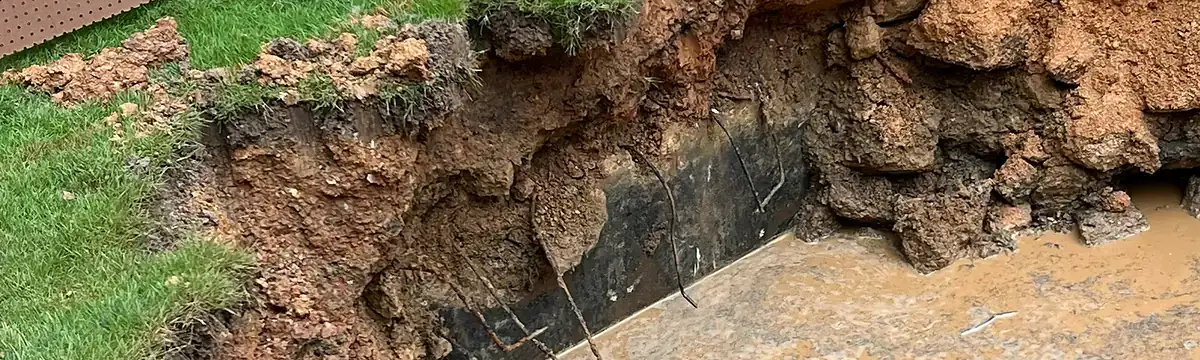
What Alabama yard drainage problems actually look like
The signs are usually present before the problem becomes severe. Mulch migrating downhill after every rain. A bare patch on a slope that plant material won't hold. Water sitting in the same low corner of the yard for two days after a storm. Sediment collecting on the driveway or sidewalk near the base of a slope. A soft area near the foundation that stays wet long after everything else has dried out.
These aren't separate problems. They're the same problem showing up in different places. Water is moving through or across the site in a way the property isn't managing correctly, and the landscape is absorbing the consequences.
Left alone, drainage and erosion problems don't stabilize on their own. A bare slope loses more soil each season. A low area that pools regularly develops compaction and soil conditions that kill turf and stress plant material. A foundation that stays wet longer than it should starts showing the effects in mortar, framing, and finished interior surfaces. The cost of waiting is consistently higher than the cost of addressing the problem when the signs first appear.
“Water decides whether a landscape lasts. Everything built above grade depends on what happens below it.”
Why Alabama clay soil makes drainage worse than you expect
Clay soil is the baseline condition across most of Alabama, and it behaves differently from what homeowners accustomed to sandier soils expect. Clay doesn't drain. It holds water, sometimes for days after a rain event. When dry it compacts and cracks. When saturated it becomes unstable. On a slope, clay that holds grade adequately in dry conditions will move when saturated. On flat ground, even soil that handles light rain will pond in a heavy event because the absorption rate can't keep pace with the volume.
The Alabama Cooperative Extension has documented a specific failure pattern on clay-heavy lots called the bathtub effect. When drainage is blocked or redirected incorrectly, water accumulates in low areas with nowhere to go. On improved lots, this happens near foundations, at the base of retaining walls, and in backyard areas graded without adequate drainage outlets. The result is standing water, saturated soil, and progressive damage to anything built nearby.
Drainage solutions in Alabama need to be designed specifically for clay. Outlet location, pipe slope, aggregate selection, and the relationship between surface and subsurface drainage all need to account for a soil type that doesn't move water the way more porous soil would.
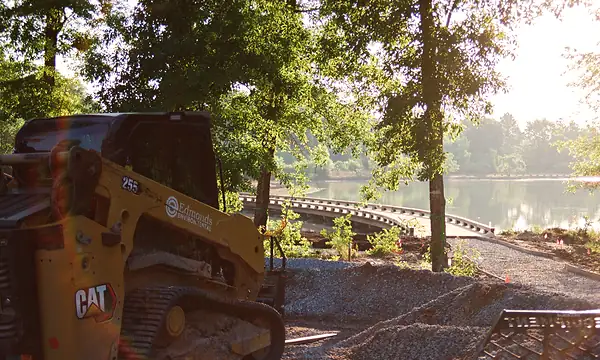
Erosion and drainage are not the same problem
They appear together often enough that homeowners treat them as one issue, but the distinction matters because the solutions differ.
Erosion is the movement of soil. Water flowing across a slope carries topsoil with it, cutting channels into the grade, exposing roots, and depositing sediment wherever the water slows. On a steep or clay-heavy slope, even moderate rain events move meaningful amounts of soil over time. The slope looks stable until it doesn't.
Drainage is where water goes after it falls. A drainage problem means water isn't routing off the site correctly and is pooling, saturating, or pressuring something it shouldn't. This can happen on flat ground with no visible erosion, or it can compound a slope problem by keeping soil continuously saturated and therefore continuously unstable.
Solving erosion without addressing drainage leaves the water that caused the erosion still present. Solving drainage without addressing the eroded slope leaves the bare ground still vulnerable. Most lasting fixes work on both.
Drainage solutions for Alabama yards: the right tool for the problem
Not every drainage or erosion problem requires the same level of intervention. The right starting point depends on severity, location on the property, and what's adjacent.
Minor corrections handle smaller problems before they compound. Mulch depth and type affect how much soil moves in rain events. Dense groundcover planting on a gentle slope adds root mass that holds soil. Downspout extensions that route roof runoff away from foundation beds solve a surprising number of pooling complaints. These approaches work when the problem is early-stage and the slope is not steep.
Grading and regrading addresses established drainage patterns that minor adjustments won't change. Reshaping contours to establish positive drainage away from the foundation, redirecting swales toward appropriate outlets, and recontouring low areas that pond are all grading corrections. This work requires equipment but doesn't necessarily require structural elements.
French drains, catch basins, and channel drains become necessary when water volume or soil type can't be solved with grading alone. French drains collect subsurface water and route it to an outlet. Catch basins intercept surface water at low points before it pools. Channel drains handle concentrated surface flow at driveway aprons and patio edges. These systems perform in Alabama clay when designed with correct outlet location and adequate pipe slope. They fail when those conditions aren't met.
Design-build integration is the right approach when drainage problems exist on a property where other improvements are also planned. A patio, retaining wall, or planting installation built on a site with unresolved drainage has a shorter service life than one built after drainage is solved. The sequencing matters more than most homeowners realize until they're dealing with a failed installation. Edmonds Environmental plans drainage as part of every project, not as a remediation step after the visible work is finished.
Drainage and erosion in Tuscaloosa, Northport, and Mountain Brook
Drainage problems show up differently across the markets Edmonds Environmental serves, and the right solution in each case reflects the specific site conditions.
Tuscaloosa
Older residential properties in Tuscaloosa often have drainage problems that trace to decades of incremental improvements made without accounting for the full site. An addition, a new patio, a reshaped bed, each change subtly redirected water and the cumulative effect shows up as a drainage problem with no obvious single cause. Backyard drainage toward rear lot lines is a common complaint, particularly on lots where rear grades drop toward alleys or drainage corridors. Downspout routing is frequently the first correction worth making before any structural drainage work is scoped.
Northport
Larger lots in Northport with grade change from street to rear of property often have drainage moving toward the low side of the lot in ways that affect usable backyard space. The volume of water moving across a larger site during a heavy Alabama rain event is significant, and drainage systems need to be sized accordingly rather than designed for average conditions. Swales, french drains, and catch basins working together as a system typically outperform any single drainage solution on these properties.
Mountain Brook
Wooded slopes in Mountain Brook contribute significant water volume during heavy rain events. Mature canopy intercepts rainfall and channels it to the trunk and root zone, concentrating water in ways that bare slopes don't. Drainage problems on these properties often involve water movement from adjacent wooded areas onto improved portions of the lot, and solutions need to account for that off-site contribution. Premium outdoor living investments in Mountain Brook are also more exposed to drainage failure because the sites are more complex and the grade changes more severe.
When yard drainage problems need a contractor
Minor work, like redirecting a downspout or adding mulch depth to a gentle slope, is manageable without professional help. The situations that warrant a site evaluation: active erosion on any meaningful slope, standing water that persists more than 24 hours after a rain event, drainage problems within ten feet of a foundation, any drainage issue adjacent to a retaining wall or hardscape investment, and any situation where the source of the water isn't clear from the surface.
A professional evaluation identifies what the site actually needs, which is frequently less than what the symptoms suggest and occasionally more. Either way, understanding the real scope before starting is less expensive than discovering it after work is already underway.
If a property is showing drainage or erosion symptoms, a site visit from Edmonds Environmental starts with grade, soil, and water movement before anything else is discussed.